


I was overseeing a digital build with a new team. The developer kept receiving design files, coding them, and then being asked for adjustments, without ever being told the "why?" Among the code team, designers were constantly dismissed as "picky."
So that day I looked to pause the cycle of frustration and explained a bit of typography to him. Not as a design lecture. As broader understanding. What affects a typeface's readability, and how context helps drive the decisions. Why leading, the space between lines, and column width, affect how the eye moves across a page. How tracking tightens or loosens the breath of a word, and its emotional meaning. Why a designer chooses one over the other, and what they are trying to do when they do so. He got quiet for a moment. Then he started asking questions.
Over the following months, something shifted. He started caring about type in ways he had not before. He read about it on his own time. He began suggesting ways of adding technical flair, and ways to improve the intention he learned to perceive, not from instructions but from understanding. He became proud of the typography work he delivered. The friction between development and design did not disappear overnight, but it diminished, because the gap between what was being designed, and why, was no longer invisible to him. He began learning more, and sharing more of his own reasoning. It evolved beyond typography, into concept and storytelling. This kind of interaction helped the dev team become part of the ideation process, contributing their field of expertise.
That is what Fluid Creativity looks like in practice. Not everyone becoming an expert in everything. Every discipline understanding enough about the others to care about what they produce, and to not be afraid to contribute.
"Fluid creativity is not about a single person or discipline. It is about a team that stays curious about every discipline at the table, where everyone shares what they know."
The creative team that existed a couple of years ago does not exist anymore. Copywriters who once wrote thirty-second scripts now also write vertical micro-dramas, agent scripts and AI prompts. Art directors and designers who learned to fill a page now build the front end of a site with WYSIWYG AI tools, ready to pass to back end dev. Everyone develops character continuity profiles, AI video prompts and edits. The tools and formats keep multiplying. The skills have to follow.
To thrive we have to stop thinking of how to defend our territory and stay curious about what is next. The ability to learn, from peers, from the work, from the discipline that sits across the table, is the core skill, not the craft specialty. The craft specialty is the foundation, and the willingness to share and keep building on it is what makes it last. This is not a linear process; it is iterative: launch and learn, test and improve, fail and iterate, succeed and multiply, customize, personalize, optimize. The work informs the next brief and the data reshapes the next concept. The learnings and creative response to a campaign become the insights for the one that follows.
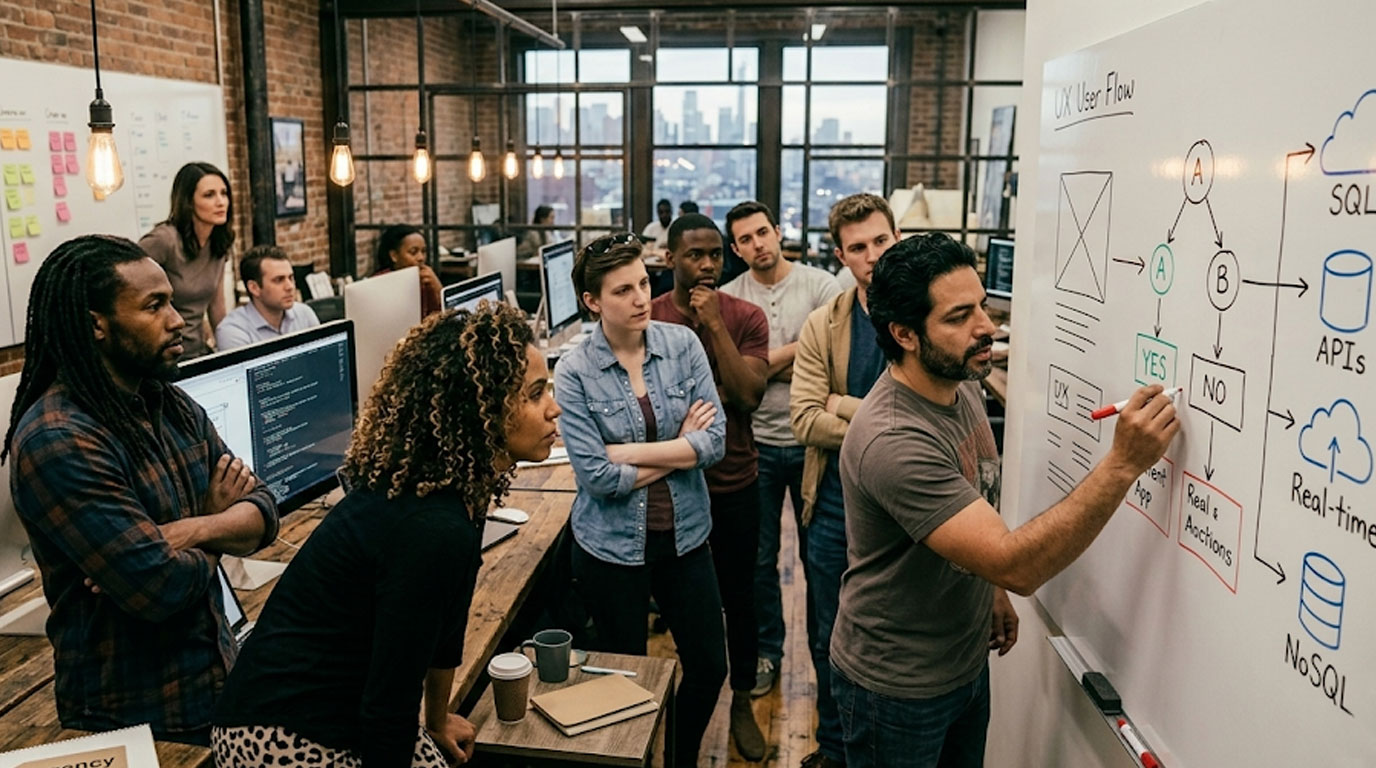
What this requires from a team is not just talent within their own discipline. It is the ability to read what the other disciplines are telling them and contribute, and help evolve the team to its next iteration. The creative director looking at a data report and seeing an idea in it. The account person sitting in a production meeting and understanding why a change takes three weeks. The developer participating in a brainstorm and asking "what if the interface did this," not as a last-minute request, but as a creative contribution from the get-go.
Some of these things may not come naturally at first, but as the openness to listen and the desire to improve, share and learn grow, so do the quality and precision of the published work.
Creativity today is flanked by technology, data, strategy, and an ever-growing variety of media touchpoints. They feed it. And creativity feeds back. This is the world it lives in and the world within which it needs to function, fluidly, with collaboration and a little Socratic modesty. Having the best idea in the room cannot be your only currency; the flow of perspectives is the mechanism and curiosity is the fuel.
If stone soup is how a team makes the idea, fluid creativity is how the idea is made better, and survives the trip to the finished work. For that we need to learn each other's language, not fluently, but enough to understand where each of us is coming from, and where we are all trying to go. When everyone understands the why, the how and the what, everyone can help get there, and by everyone I mean as many as possible: accounts, research, strategy, media, dev, creative, social, content.
Work in silos, in a waterfall of handoffs, and the purpose and the detail will get diluted with every step. A great idea with an awful media release still flops, and the same is true of every other discipline along the way. The developer receiving files with no why is that story in miniature. Without the respect and participation that create ownership, care for the quality of the work fades. People see what is wrong, or how to improve it, and do not care enough to speak up, or to go the extra mile.
When the silos come down across a whole team, everyone is working toward the same thing: making the work better. The work ends up with more intelligence in it than any one person could have put there, holding together under pressure, adapting and finding unique solutions in places the brief did not naturally point to. That is fluid creativity, where collaboration is a team's superpower.
Explore more points of view




Ready to Get Unstuck?
Let's craft breakthrough campaigns that resonate across global markets and drive meaningful brand connections. Or simply ruminate.